From a Weekend Retreat to a House in the Country A thirty-year long learning curve.
e-mail:
  • Home
  • Posts
  • About Snow Fences
  • Building a Reusable Snow Fence
  • Building a pond
    • Pond Building Distaster
    • Pond Building Success
    • Pond Impressions
  • Logging begins
    • Logging coninues
  • Bald Eagle
  • Mowing lawns
  • Spring
  • Hummingbirds
  • Planting a vegetable garden
  • Garden Watering Made Easy
  • Best Mouse Trap
  • Summer Pleasures
  • Protecting your house.
  • Woodstoves
  • About Firewood
  • Firewood Shed
  • Snowed in
  • Contact
  • Home

Life Under the Snow

12/28/2016

0 Comments

 
Picture

Life Under the Snow

Picture
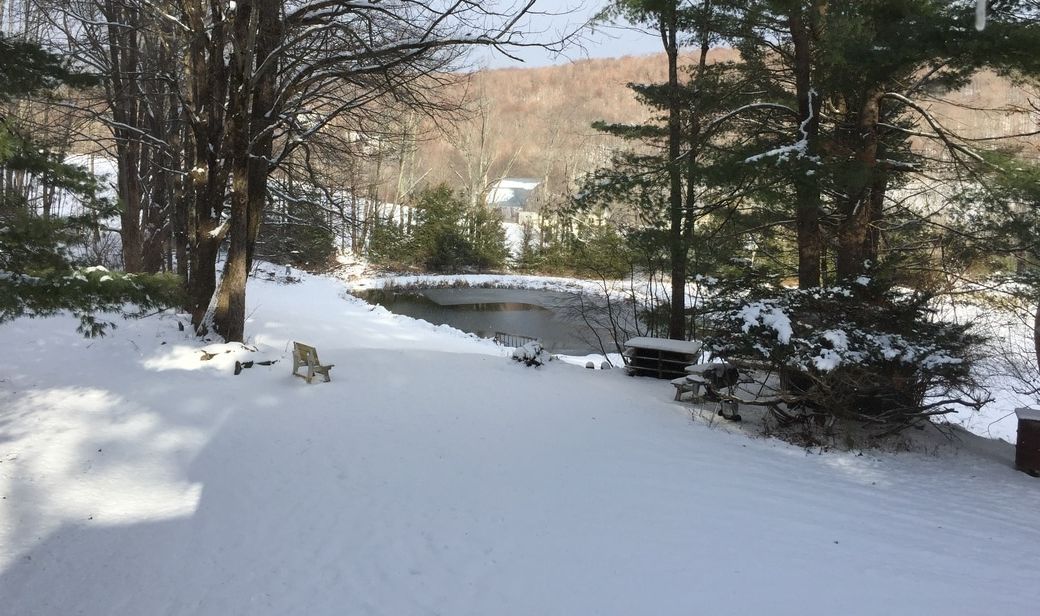
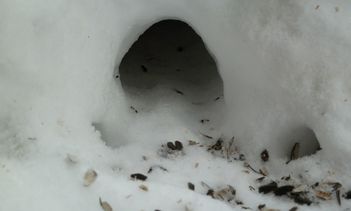
​When I look out my window, Winter has put a white blanket on the ground as far as I can see. It looks untouched and very peaceful. The other day, when I was filling the bird feeder in front of the house, I noticed quite a few holes in the snow. They were the size of a quarter and not vertical, but horizontal.  I was puzzled.  But watching them from the bay window of the house, I saw little field mice and red squirrels poking their heads out, grabbing some bird seeds and disappearing into their holes again.
Picture
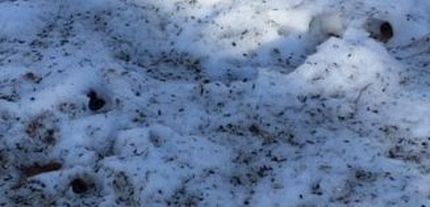
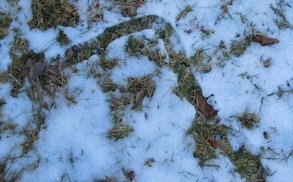
                           I had just found an entrance to the “Subnivean Zone”, a place under the snow where field mice, voles and other animals make their cozy winter homes. Subnivean Zone is a scientific term, meaning  under the snow. Vegetation, leaf debris or branches help to physically hold up the snow, which forms an open space which will be used by small mammals. The interior tunnel walls form into a hardened layer as well, making the tunnels more durable. This is probably due to the packing of the walls by the residents’ bodies as they move through them, the freezing of the exhaled moisture in their breaths and air drafts in the tunnels. I first noticed these wandering lines in the melting snow one Spring as the snow cover slowly turned to a slushy, semi-transparent, grey layer on my back lawn. I could see white, rope-like lines snaking along the ground on the surface of the lawns.
Picture
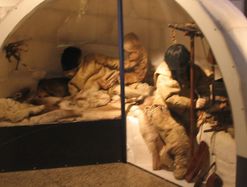
Much like our classic image of the eskimo igloo home, made from cut blocks of snow, this habitat offers a constant interior temperature of around 32 degrees or more, regardless of the colder temperatures outside. Indeed, temperatures inside a classic eskimo igloo can become quite comfortable, despite the fact that the abode is made of ice! The heat from their bodies, the condensation of the moisture in their breaths and the warmth from the small seal or whale fat candles used for light, help create a refrozen layer of ice on the interior walls that adds stability and sealing inside. Add some caribou, wolf or bear hides for bedding, and you have a very livable abode!​

What mankind wrought with the igloo, was just a re-creation of the dens in the subnivean world, where animals have used dead leaves, grass, etc. as insulation and bedding.

The subnivean zone has a lot to offer. It protects those small mammals from the cold temperatures, bitter winds and many of the hungry predators. It takes only six inches of snow for a sturdy roof and ample living space to be formed.

Many animals like mice and voles depend on this habitat under the snow for winter survival. They eat plants, seeds and bark from shrubs. They also store up small amounts of food to make sure there is always something to eat. They can be active all winter, but they may also huddle together in a deep sleep.

They have a series of tunnels under the snow to make travel easier. Those tunnels are highways between their sleeping quarters to my bird feeder and caches of food they gathered in the Fall. Of course, those holes also act as ventilation shafts between their home and their food supplies.
Picture
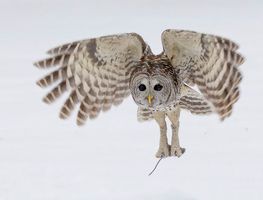
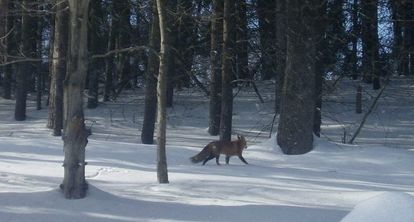
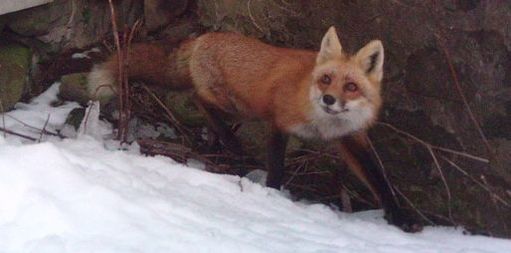
Living under the snow offers a lot of protection, but owls for example can hear rodents running in the tunnels from 30 yards away. Forming a ball with their feet they are able to punch through the top layer of snow and grab their prey. Foxes and coyotes detect animals under the snow by scent and sound as well and will pounce and dive right in for the meal. I remember one Winter watching a red fox trot across the unbroken expanse of snow in a field near the house. He stopped suddenly pricked his ears forward to a spot about a meter to his side and began to twitch his head slightly from side to side while staring intently at the blank spot in the almost knee-deep snow cover. After a few moments, he launched himself into an arcing leap and came down like an arrow, front paws together and nose to paws, burying himself up to his shoulders. A moment later he popped up with a vole in his mouth and trotted away. At the time I thought it was a lucky grab, but I was wrong.
Picture
Picture
​At the end of the winter those tunnels become visible and you cannot help but admire those creatures. The complexity and extent of this hidden world slowly emerges into view as the snow melts. There is a whole complex web of life active in the apparently barren landscape of Winter, just below our view.

There is more life around you than you can see.
Picture
0 Comments

Drone for the Holidays?

12/12/2016

0 Comments

 
Picture

Drone for the Holidays?

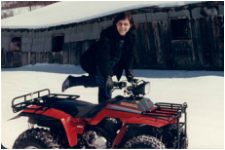
PictureOne of our two ATVs
The holidays are upon us and we are thinking about gifts.  I was wishing for a drone and was dreaming of flying it above our country fields and woods,   watching the wildlife from a different perspective. I imagined what great footage I could get as our wildlife would not consider a drone a threat. I may have been very wrong!

There is a reason the DEC doesn’t allow hunting/shooting game from atvs. A human form moving through the woods alarms most creatures. A human sitting on an atv can drive up almost to within throwing distance of many animals- they don’t recognise the human threat. (Think safari videos of gaggles of humans sitting in a Land Rover,  driving within almost touching distances of lions in Africa.) Animals aren’t alarmed by humans disguised by the overall form of something they are placed inside. Hunting blinds are a good example.

So I imagined, that a drone would not alarm much of our wildlife- as it wouldn’t appear in anyway human, and I would be able to get ‘up close and personal’  with many of the animals that visit us.

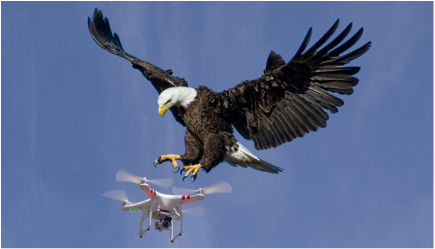
PictureBald eagle attacking a drone
I did my research and found out that drones start at $50 for a child’s toy and they can go up well over $ 10,000.  While I was typing, my computer informed me that this holiday season 12 million drones will be sold, up 112% over 2015! This is clearly where everyone is going.

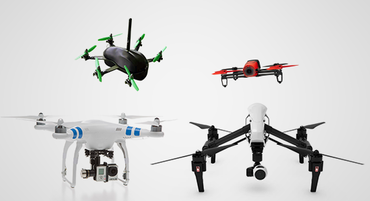
As everything looks great on a computer screen, we went to a store to have a closer look at the different models. It is amazing what is available for comparatively reasonable money, considering the HD video camera and the navigational technology.  Drones can now follow you around like pets- hovering above you and following you around (and avoiding obstacles all on their own) to take ‘selfies’ of you as you mountain bike, surf big waves or paddle thru rivers. The technology is unbelievable and just what we wanted for our wildlife photography!

We did our research and went to a ‘big box’ store to see the different models they had to sell, and to make some kind of evaluation. We had almost settled on one when I heard the sales person say, “Too bad that drones get attacked so often by eagles and hawks. You need to consider that in the ‘flying environment’ (very rural) you described to me. ”

Well, this was a revelation! I had never heard that and wanted to know more.  After all, With the growing number of bald eagles we referenced in our post http://www.countryforcity.com/bald-eagle.html (and our perennial red tailed hawks and owls), sending a $1,000+ drone on a one-way suicide mission for a photograph seemed stupid! When I researched this fact, a whole new world opened up for me. YouTube offers numerous short videos of eagles flying in, and they get bigger and bigger and the last thing you see are the claws. This is the end of an expensive drone!

​
But there is also another very interesting side to drones. I learned that in the Netherlands the police have trained eagles to attack drones and have formed an “Eagle Squad”. The police know that drones are used for drug trafficking and they also use the trained eagles to fight possible terrorism. There is growing concern in law enforcement that consumer-grade drones can be used for terrorism. Trained birds of prey are cheap and highly effective defensive measures.

Another story brings me to Australia. Here the drones are used in prospecting by a big mining company. They use very expensive and specialized drones equipped with sophisticated sensors,  to fly around the expansive area of Western Australia, looking for favorable spots to mine for gold. This plan was short lived, as the Australian eagle considered those drones as intruders into their territory and brought them down and destroyed them.

“In an attempt to prevent the attacks, the mining company resorted to camouflaging the drones as baby eagles, but the technique only worked temporarily, namely for 50 flights. The eagles were incredibly smart and soon woke up to the trickery. They are extremely territorial and considered the drones a threat.” A headline in the paper read: Eagle 9, drone 0. A loss of almost $100,000.

​
So, if you want to make a child happy with a drone for your backyard, it probably will work very well. They are great tools to teach hand-eye coordination. My wish for a drone to take impressive wildlife videos, may however, be more carefully considered.


0 Comments

    >This is about our journey from being Big City people to learning how to embrace a country lifestyle. 

    We bought an old farmhouse (built in the 1850's); we have hay fields and woods, streams, bridges and a long drive way. Our neighbors are far away. We are so far away that we have to go to the post office to get our mail. For us it has been paradise.

    Archives

    July 2021
    June 2021
    May 2021
    April 2021
    March 2021
    February 2021
    January 2021
    December 2020
    November 2020
    October 2020
    September 2020
    August 2020
    July 2020
    June 2020
    May 2020
    April 2020
    March 2020
    February 2020
    January 2020
    December 2019
    November 2019
    October 2019
    September 2019
    August 2019
    July 2019
    June 2019
    May 2019
    April 2019
    March 2019
    February 2019
    January 2019
    December 2018
    November 2018
    October 2018
    September 2018
    August 2018
    July 2018
    June 2018
    May 2018
    April 2018
    March 2018
    February 2018
    January 2018
    December 2017
    November 2017
    October 2017
    September 2017
    August 2017
    July 2017
    June 2017
    May 2017
    April 2017
    March 2017
    February 2017
    December 2016
    October 2016
    September 2016
    August 2016
    July 2016
    June 2016
    May 2016
    April 2016
    March 2016
    February 2016
    December 2015
    October 2015
    September 2015
    August 2015
    July 2015
    June 2015
    May 2015

    RSS Feed

    Building a pond
    Cats In Country
    Country Cats
    Country Lifestyle
    Country Living
    Farmhouse
    Farm Lifestyle
    Farm Living
    Firewood
    Hummingbirds
    Huskies
    Making A Pond
    Snow Fence
    Snow Fences
    Vegetable Garden
    Vegetable Gardening
    Weekend Retreat


    All

    Subscribe for free!
Photos from Marco Verch (CC BY 2.0), janicebyer, BillDamon, chumlee10, Kaibab National Forest, David Jakes, Tony Webster, billmiky, Bering Land Bridge National Preserve, Gunn Shots., It's No Game, girlgeek0001, frankieleon, Tony Webster, marcoverch, berniedup